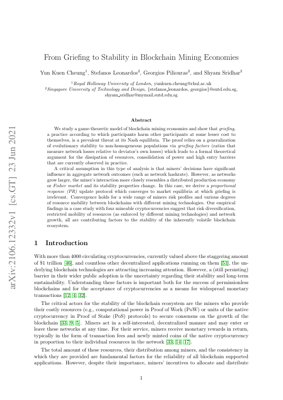
From Griefing to Stability: A Game-Theoretic Analysis of Blockchain Mining Economies
Analysis of griefing behavior in blockchain mining, its impact on network stability, and the convergence to market equilibria via proportional response protocols.
Home »
Documentation »
From Griefing to Stability: A Game-Theoretic Analysis of Blockchain Mining Economies
1. Introduction
The blockchain ecosystem, valued over $1 trillion, faces a critical challenge regarding its long-term stability and sustainability. The decentralized nature of mining, where participants (miners) provide resources (hash power in PoW, stake in PoS) for rewards, creates a complex game-theoretic environment. This paper investigates the prevalence of griefing—where miners harm others at a lesser cost to themselves—in blockchain mining economies and explores pathways to stability.
Miners' self-interested behavior and ability to freely enter/exit networks are fundamental to blockchain security but also introduce volatility. Understanding their resource allocation incentives across multiple blockchains is crucial for predicting network reliability.
2. Model and Theoretical Framework
The analysis builds upon a game-theoretic model of a mining economy comprising single or multiple blockchains.
2.1. Mining Economy Game Model
The model considers miners who allocate computational resources (or stake) across one or more blockchains. Rewards are distributed proportionally to contributed resources, as is standard in many PoW and PoS protocols. The work extends the Nash Equilibrium (NE) analysis of [3], which derived unique NE allocations under this proportional scheme.
2.2. Griefing and Evolutionary Stability
The core theoretical innovation is linking griefing behavior to the concept of evolutionary stability. The authors quantify a miner's deviation impact using griefing factors—ratios that measure the total network loss relative to the deviator's own loss. This formalizes the intuition that a miner may accept a personal loss if it inflicts a disproportionately larger loss on competitors, destabilizing the network.
3. Technical Analysis & Results
3.1. Griefing at Nash Equilibrium
The paper proves that at the predicted NE, active miners still have incentives to unilaterally increase their resources (Theorem 1, 6). While this may reduce their absolute payoff, it increases their relative market share and inflicts greater harm on other miners (Corollary 7). This establishes griefing as a rational, prevalent strategy at equilibrium, leading to resource dissipation and increased centralization—phenomena observed in real-world mining pools.
3.2. Proportional Response Protocol
A key contribution is the analysis of large networks where individual miner influence diminishes. Here, the system resembles a Fisher market or distributed production economy. The authors derive a Proportional Response (PR) update protocol. They prove that this protocol converges to market equilibria where griefing incentives become irrelevant, regardless of miners' risk profiles or resource mobility constraints between different blockchain technologies.
3.3. Empirical Case Study
The theoretical findings are supported by an empirical study of four mineable cryptocurrencies. The results suggest that three factors contribute to ecosystem stability:
Risk Diversification: Miners spreading resources across chains.
Core Insight: The paper delivers a powerful, counter-intuitive punch: the very Nash Equilibrium that should represent stable, rational behavior in blockchain mining is, in fact, a hotbed for destructive griefing. This isn't just about selfish mining; it's about rationally choosing to burn value to burn others more. The authors brilliantly reframe this not as a bug, but as a fundamental property linked to evolutionary game theory's concept of stability. This connects the opaque world of crypto-mining to decades of established biological and economic competition models, as seen in the foundational work on evolutionary stable strategies by Maynard Smith and Price. It explains the persistent, frustrating trends of hash power consolidation and wasteful over-investment not as market failures, but as predictable outcomes of the current incentive structure.
Logical Flow: The argument is elegantly constructed. First, they establish the baseline NE (Theorem 1). Then, they probe its fragility by showing any miner can profitably deviate to cause net harm (Theorems 6, Corollary 7), introducing the griefing factor metric. This creates the tension: equilibrium exists but is destructive. The resolution comes from scaling. They argue that as networks grow, the system's mathematics morph from a classic game into a Fisher market—a model studied extensively in algorithmic game theory for resource allocation. In this new regime, they prove a simple Proportional Response dynamic converges to equilibria where griefing is neutered. Finally, they validate this transition with empirical data from four cryptocurrencies, showing how real-world factors (diversification, friction) push networks toward this stable state.
Strengths & Flaws: The major strength is its dual theoretical-empirical approach and the novel linkage of griefing to evolutionary stability. The Proportional Response protocol is a significant, practical contribution. However, the analysis has limitations. It heavily relies on the proportional reward assumption. How do griefing dynamics change in hybrid models or under novel mechanisms like Ethereum's proposer-builder separation? The Fisher market analogy for large networks is compelling but may break down during extreme volatility or coordinated attacks, scenarios where the "large number of small agents" assumption fails. Furthermore, while the case study is valuable, four cryptocurrencies is a small sample. A broader analysis across DeFi protocols, L2s, and newer PoS chains is needed to test generalizability.
Actionable Insights: For protocol designers, this paper is a mandate: stop designing for static Nash Equilibrium alone. Instead, design update rules (like PR dynamics) that guide the system toward griefing-resistant market equilibria. For investors and analysts, the framework provides a lens to assess chain stability. A chain with low miner diversification and high resource mobility is primed for griefing-driven volatility. Conversely, growth, technical friction (like specialized hardware), and multi-chain mining are bullish signals for long-term stability. Regulators should note that policies encouraging miner concentration (e.g., through geographic energy subsidies) may inadvertently strengthen griefing equilibria. The future lies in mechanism design that explicitly minimizes the griefing factor, moving beyond simple reward proportionality.
6. Technical Details & Mathematical Formulation
The griefing factor $G_i$ for miner $i$'s deviation is formally defined as:
where $\pi_i^c$ is the payoff from chain $c$, and $R_i$ is the miner's total resource. This update rule converges to a market equilibrium where $\frac{\pi_i^c}{x_i^c}$ is equalized across all chains for each miner, eliminating the marginal benefit of griefing.
7. Experimental Results & Chart Description
The empirical case study analyzed data from four mineable cryptocurrencies (likely including Bitcoin and Ethereum Classic among others). While the PDF excerpt does not show specific charts, the described results would typically be presented through:
Time-Series of Network Hashrate Distribution: Showing how mining power consolidates or diversifies among pools over time, correlating with price volatility events.
Griefing Factor Calculation over Time: A plot estimating the griefing factor based on observable pool size changes and reward data, demonstrating periods where the factor exceeds 1 (active griefing).
Correlation Matrix: Showing the empirical relationship between network size, miner count, resource mobility metrics, and measures of reward variance or stability. The key finding is negative correlation between network size/miner count and volatility, supporting the Fisher market transition hypothesis.
The data supported the conclusion that larger, more fragmented networks with higher barriers to resource reallocation exhibited greater stability, aligning with the theoretical prediction of griefing dissipation at scale.
8. Analysis Framework: Example Case
Scenario: Analyzing a potential new Proof-of-Work blockchain, "ChainX."
Framework Application:
Calculate Baseline Griefing Potential: Estimate the initial miner distribution. If 2-3 pools are projected to control >50% hashpower, the griefing factor at NE is likely high (>1).
Assess Resource Mobility: Is ChainX using a common algorithm (e.g., Ethash) allowing easy GPU migration, or a novel ASIC-resistant algorithm creating friction? Low friction increases short-term griefing risk.
Project Growth & Diversification: Model the adoption curve. Fast growth dilutes pool power, pushing the system toward the stable PR convergence regime. A plan to attract a diverse miner base is critical.
Protocol Design Check: Does ChainX's reward mechanism purely follow proportional payouts, or does it incorporate elements (like randomness or smoothing functions) that could alter the griefing calculus? The paper suggests exploring PR-like update rules in the protocol logic itself.
Verdict: Using this framework, an analyst could flag ChainX as high-risk for griefing-driven instability in its first 12-18 months if it launches with concentrated mining and a common algorithm, recommending measures to encourage miner diversity and potentially modify reward distribution.
9. Future Applications & Research Directions
Mechanism Design for Griefing Resistance: Designing new consensus or reward mechanisms that explicitly minimize the griefing factor, moving beyond proportional rewards. This could involve Vickrey-Clarke-Groves (VCG) inspired mechanisms or reputation-based systems.
Cross-Chain & Multi-Protocol Stability: Applying the framework to decentralized finance (DeFi), where liquidity providers across protocols face similar griefing-like dilemmas (e.g., impermanent loss exploitation).
Policy & Regulation: Informing regulatory approaches to mining concentration and sustainability. Policies could be designed to encourage the diversification and friction that naturally lead to stable market equilibria.
AI & Multi-Agent Simulation: Using the model to train AI agents that simulate miner behavior in complex, multi-chain environments, stress-testing new protocols before deployment.
Extension to Proof-of-Stake: Deepening the analysis for PoS systems, where "resources" are financial stake rather than hashpower, and griefing may take different forms (e.g., voting cartels).
10. References
Cheung, Y. K., Leonardos, S., Piliouras, G., & Sridhar, S. (2021). From Griefing to Stability in Blockchain Mining Economies. arXiv preprint arXiv:2106.12332.
Nakamoto, S. (2008). Bitcoin: A Peer-to-Peer Electronic Cash System.
Eyal, I., & Sirer, E. G. (2014). Majority is not enough: Bitcoin mining is vulnerable. In Financial Cryptography and Data Security (pp. 436-454). Springer.
Buterin, V., et al. (2014). A next-generation smart contract and decentralized application platform. Ethereum white paper.
Maynard Smith, J., & Price, G. R. (1973). The logic of animal conflict. Nature, 246(5427), 15-18. (Foundational work on Evolutionary Stable Strategies).
Nisan, N., Roughgarden, T., Tardos, É., & Vazirani, V. V. (Eds.). (2007). Algorithmic Game Theory. Cambridge University Press. (For Fisher markets and algorithmic mechanisms).
CoinMetrics.io, Blockchain.com Data. (Empirical network data sources).